Mike’s fall and trampling by Tabasco
Cry MachoMike’s fall and trampling by Tabasco is the abrupt reversal at the center of Mike Milo’s celebrated Ride-Out: after appearing to master a famously difficult bronc, Mike is thrown and left unable to rise. The episode turns applause into alarm and makes the rodeo’s image of the invulnerable cowboy collide with the limits of the aging rider’s body. It also establishes the injury that sends him to the hospital, where pain, a cast, and memories of earlier injuries frame the next stage of his story.
The Arena and the Ride-Out
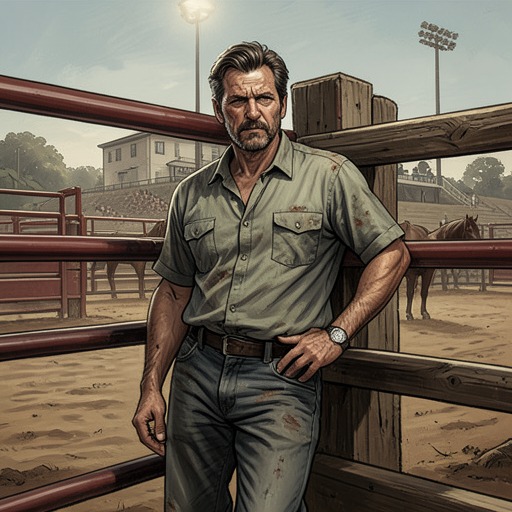
The accident takes place at Polk’s Cow Stadium, where a huge banner and an enormous poster photograph of Mike present the rodeo as a public spectacle. The photograph shows him on a rearing bronc, hat aloft and wearing the fixed grin of a cowboy hero. Mike has trained himself not to notice it. Taken during his last year of competition, the image belongs to a period when he had won little money or recognition, suffered a fractured leg and a broken kneecap, and found the road between arenas and the nights in motel rooms increasingly difficult. The public likeness promises effortless command; the private history behind it is marked by injury and strain.
The stadium itself reflects Howard Polk’s transformation of the rodeo into a regular entertainment. The Macmillan Brothers had brought him in to manage an arena that had struggled to draw audiences, and within two years the resident company was performing every night except Monday. Howard’s success did not make him popular with the cowboys. He challenged their self-image as competitive heroes, insisting that the salaried performers were actors rather than National Finals contenders. Against that background, Mike’s Ride-Out is both an athletic trial and a staged display of the very heroism Howard questions.
The announcer introduces the Ride-Out as a special event in which the rider stays on the bronc until either the man is thrown or the horse goes quiet. Mike is presented as the rodeo’s star, with three National Finals victories, the Dallas Buckle for bareback riding, and nine Cattlemen Trophies to his credit. The event’s terms make its danger plain: unlike a timed ride, it continues until one of the two participants yields. Mike nods to Barrows, the chute boss tightens Tabasco’s flank strap, and the agitated horse rears and bucks before Mike mounts. Once the gate opens, the contest is underway before the crowd.
Apparent Mastery and Sudden Reversal
The ride first appears to deliver the outcome its presentation promises. Tabasco bucks violently, but the sequence ends with the horse calm and Mike still mounted. He rides the subdued animal with deliberate ease, lifts his hand in a graceful salute, and raises his white beaver hat. The crowd understands the gesture as proof of control and answers with louder cheers. Mike’s display draws on the familiar cowboy performance: a rider appears not merely to survive a wild horse but to handle it with casual elegance.
For Mike, the victory has an immediate physical dimension as well as a public one. Waving no longer hurts his arm; the ache that had affected him is gone in that moment. He waves harder, then performs his signature flourish, throwing the hat high and riding to catch it as it falls. The crowd calls his name, and the apparent recovery of his strength becomes part of the spectacle. The sequence briefly reverses the signs of age and injury: the rider whose career has been shadowed by pain seems restored under the arena lights.
That reversal does not last. Having taken in the applause and the bottles thrown onto the field, Mike turns Tabasco toward the catch pens to leave. Just as he approaches the open gate, the horse rears and twists. Mike is unprepared and is thrown. He hears the crowd’s dismayed response and tries to get to his feet, but cannot immediately rise. Tabasco is again in motion close beside him, and the arena’s earlier celebration gives way to alarm.
People rush toward the scene from the chutes and alleyways, while the crowd stands and screams. Mike eventually gets to his knees and then stands, but he is hobbling and stumbling. He searches for his hat, drops it, picks it up again, and waves it to reassure the audience that he is all right. The gesture repeats the triumphant hat-waving of the ride, but its meaning has changed: it is now an effort to show that he can stand after the fall. The crowd answers with affection and excitement, yet Mike falls once more. This time he does not get up.
Hospital Aftermath
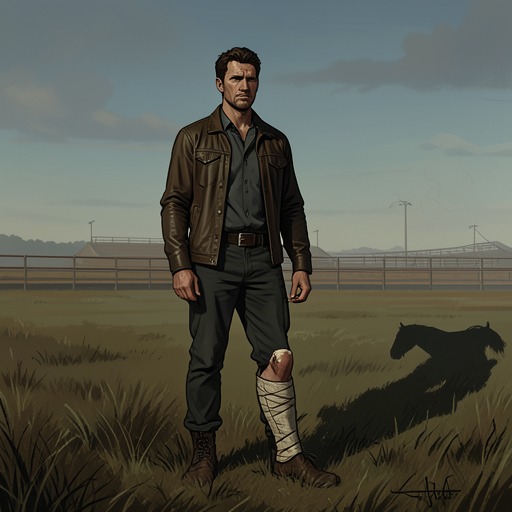
The next chapter finds Mike lying still in a hospital bed. He has a cast on his leg, pain across his body as the anesthesia wears off, and no feeling in the leg. His confused thoughts briefly compare his condition with that of a crippled horse that might be put down, before he insists to himself that he is not an animal. The hospital scene confirms that the fall has ended the performance and brought him into a condition of dependence and uncertainty.
The cast also connects this accident to a longer history rather than presenting it as an isolated misfortune. Mike tries to sort out which of his injuries and casts belongs to which moment in his life; he remembers casts on his left wrist, right arm, and right leg. His mind moves among earlier injuries and relationships, including a time when Donna tried to mother him, and then toward the losses that shaped his life before the rodeo. The accident thus precipitates a disordered recollection of personal history, as physical pain and impaired sensation unsettle the distinction between present and past.
Meaning of the Fall
The Ride-Out dramatizes the gap between the rodeo’s heroic image and the human cost it conceals. Mike’s poster and the announcer’s list of honors frame him as an exemplary star, while Howard’s criticism of the cowboys as performers exposes the arena’s theatrical construction of cowboy identity. Mike’s elegant salute and signature hat flourish make mastery visible, but the sudden fall shows how fragile that image is: the same horse that seemed subdued can still throw him, and applause cannot restore his ability to stand.
A later encounter with an illegal cockfight sharpens the episode’s thematic meaning. Watching the crowd praise a rooster’s bravery, Mike recognizes that the word macho has accompanied contests of animal and human violence across Texas, Oklahoma, Arizona, and Mexico. He sees the heroic label beside the cruelty of the spectacle and reflects that he has given the first half of his life to arenas and would gladly give the second half as well, even while grieving that nobody wants him anymore. The fall at Polk’s Cow Stadium anticipates this conflict without resolving it: Mike’s skill remains real, but the applause that crowns it is inseparable from the danger the performance asks him and the animals to endure.